
Sweet & Spicy Zucchini Relish (Canned, Refrigerator, Freezer)
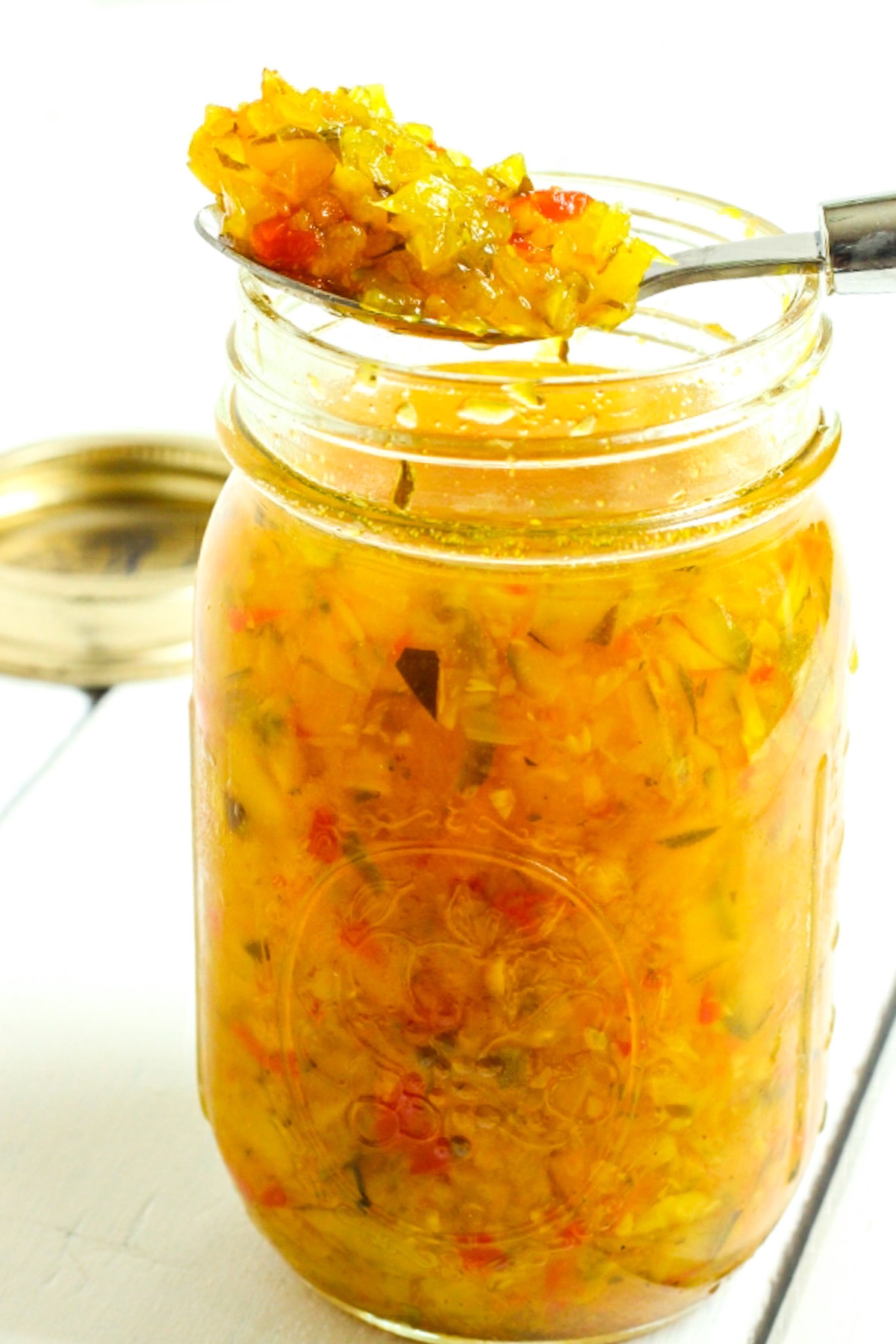
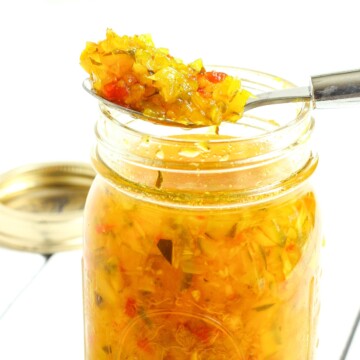
If your garden is overflowing with zucchini, this homemade sweet-and-spicy zucchini relish is the best way to use it — a vibrant, sweet, spicy condiment made with zucchini, peppers, apple cider vinegar, and warm spices like turmeric and nutmeg.
This easy zucchini relish recipe is a family favorite that I make every summer. It’s also been a reader’s favorite on this site for over a decade, and it’s easy to see why. It goes on everything from burgers and turkey sandwiches to pasta salad and deviled eggs.
I’ve updated this recipe to include:
- Detailed how-to instructions with photos
- Helpful tips from my own years of making it, as well as readers’ comments
- Guidance on water bath canning, refrigerator or freezer storage
- Answers to readers’ most common questions
Dietitian tip: I wouldn’t exactly call relish a “health food”, but this recipe is healthier than most. It’s much lower in sugar than traditional zucchini or pickle relish recipes (with a sugar-free option), AND it’s jam-packed with garden-fresh veggies. It’s also made with apple cider vinegar, which has been shown to have a favorable effect on blood sugar and cholesterol levels from acetic acid.
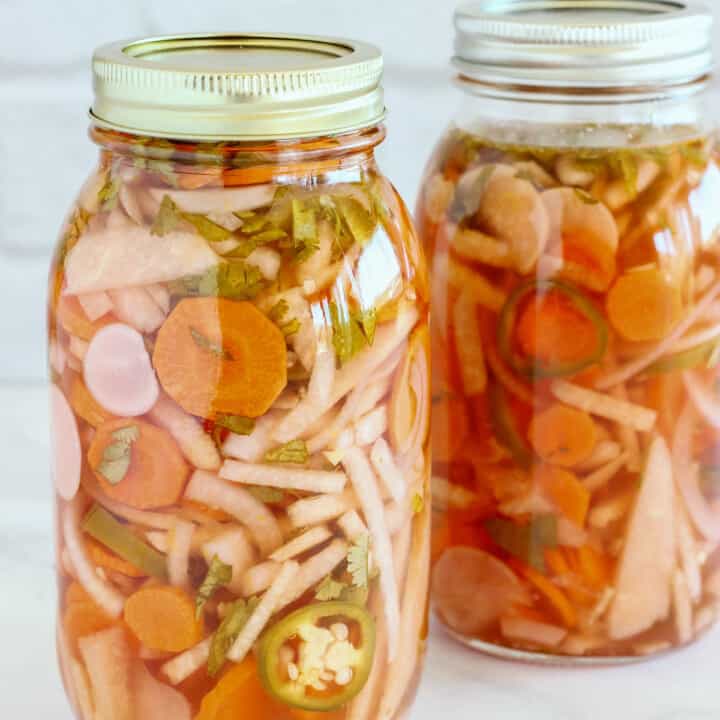
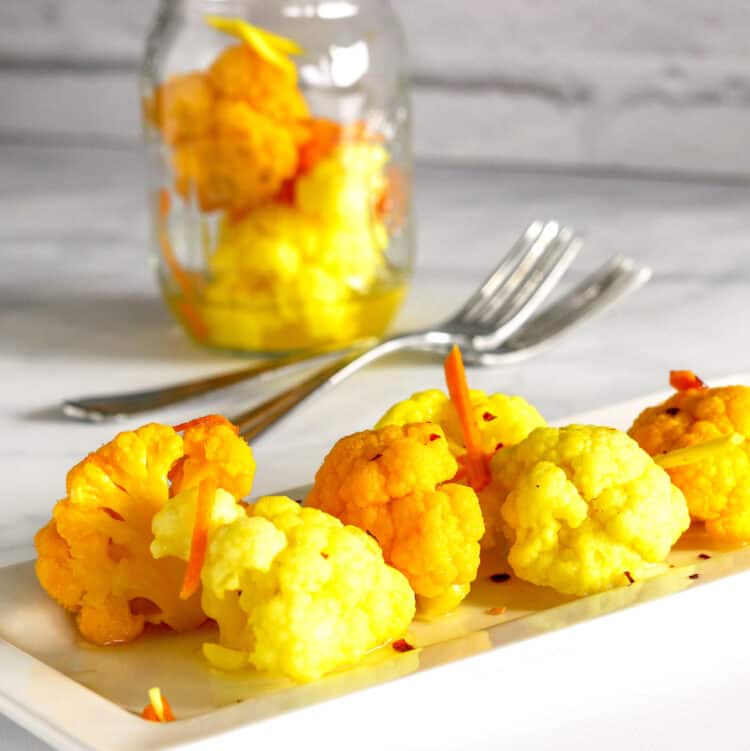
If your mouth waters thinking about all of these pickled flavors, be sure to try my easy refrigerator zucchini pickles and pickled cauliflower too. And if you love a sweet zucchini treat, try my healthy lemon zucchini bread recipe.
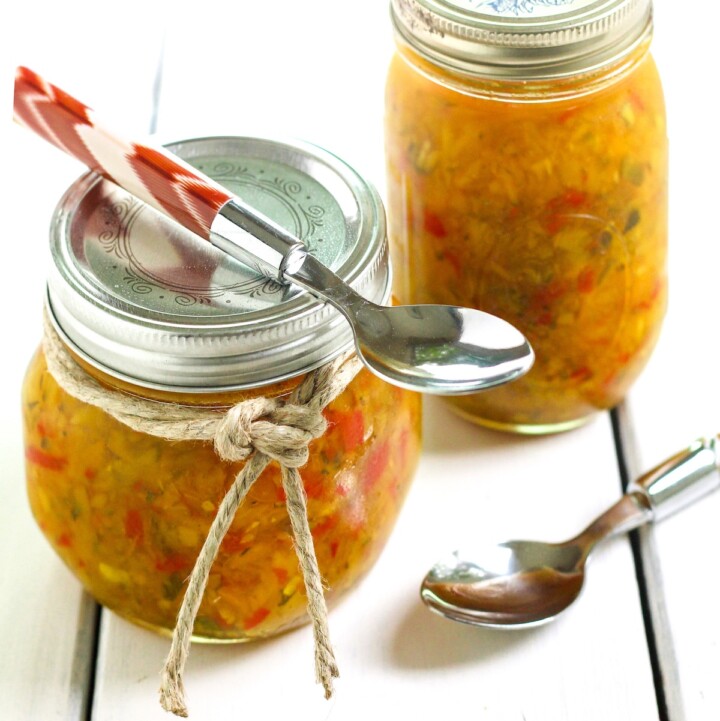
Recipe At-A-Glance
PREP TIME: 15 minutes (plus 2+ hours brine time)
COOK TIME: 45 minutes
TOTAL TIME: 3+ hours
MAKES: 8 cups/2 quarts
DIFFICULTY: easy-moderate
RECIPE HIGHLIGHTS: A flavorful and versatile zucchini relish with instructions for refrigerator, freezer, or water bath canning storage methods
FEATURED INGREDIENTS: zucchini, sweet peppers, jalapeños, apple cider vinegar, spices
This post contains affiliate links for products I use and recommend, meaning, at no additional cost to you, I may earn a commission if you click through and make a purchase.
Why You’ll Love This Recipe
What’s the Best Zucchini for Relish?
For the best texture and easiest prep, choose fresh, small to medium-sized zucchini (about 6-8 inches long). Make sure there are no soft spots or large blemishes on the skin. Smaller zucchini have softer skin, fewer seeds, and a firmer flesh, while large zucchini may be spongy.
That said, readers have told me they’ve used one giant zucchini from their garden to make this relish, and it works just fine. If your only option is a large zucchini, cut it in half lengthwise, then use a spoon to remove any seeds from the inside before chopping.
You can also use half zucchini and half yellow summer squash for this recipe, or substitute summer squash for zucchini. They have a very similar taste and texture.
Recipe Ingredients
Here are the key ingredients needed to make this zucchini relish. Substitutions and variations are listed in the section below.
Be sure to check out the recipe card below for the complete list of ingredients with measurements.
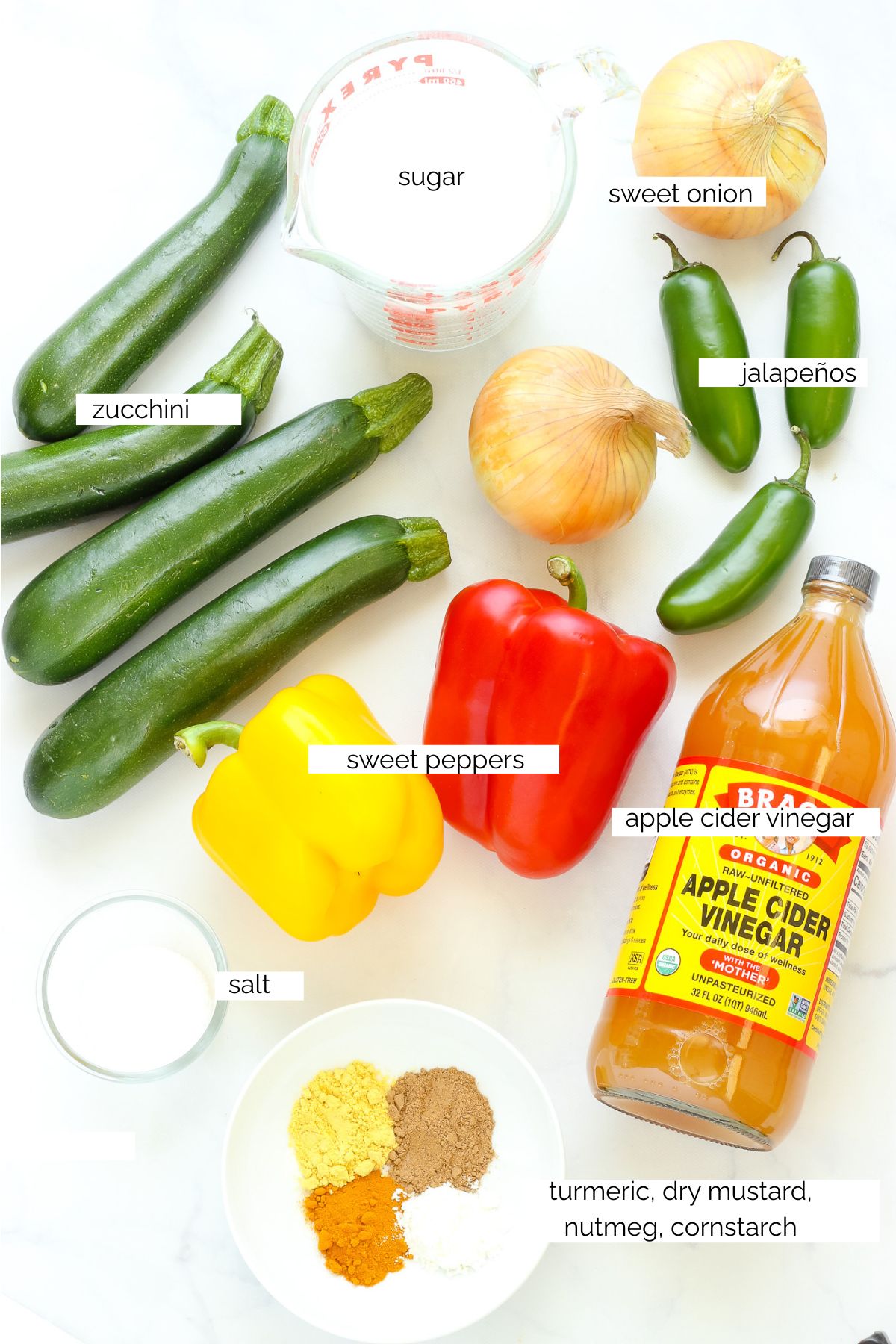
Zucchini – You’ll need about 2 ½ pounds or six small to medium zucchini. As mentioned in the section above, make sure they’re fresh and have unblemished skin.
Peppers – Use a combination of sweet bell peppers (red, yellow, and orange) plus a few jalapeño peppers for beautiful colors and the perfect blend of sweet and hot.
Onions – I love Vidalia or another sweet onion variety for a mild sweetness. White or yellow onions have a sharper flavor.
Apple cider vinegar – I recommend Bragg organic apple cider vinegar for its crisp, slightly sweet flavor that complements all of the ingredients in this recipe. It’s also unfiltered and contains “the mother,” that cloudy substance in the bottle that’s a collection of healthy bacteria.
Salt – This flavors the vegetables and helps draw excess moisture from them. You’ll need 3 tablespoons, but much of it gets rinsed away before you cook the vegetables.
Sugar – White sugar has the cleanest, sweet flavor for relish. It’s also essential for preservation if you’re canning this recipe in a water bath.
Spices – Turmeric, dry mustard, and nutmeg are a must for that classic relish flavor. They also add lots of antioxidants to this recipe.
Substitutions and Variations
- Make it hotter by using habanero peppers instead of jalapeños, but be careful! Learn more about just how hot habaneros are, and how to handle them, in my mango habanero salsa recipe post.
- Make it milder by using poblanos or regular green bell peppers instead of jalapeños.
- Substitute some or all yellow summer squash for the zucchini.
- Add other minced garden vegetables like firm green tomatoes, tomatillos, celery, or cucumbers.
- Make it low carb – Use less sugar or a zero-calorie sweetener like Lakanto or Swerve in place of the sugar, but ONLY if you plan to store this in the refrigerator or freezer.
How to Make Zucchini Relish
1. Rough cut your ingredients. Cut your zucchini, peppers, and onions into large chunks. This makes it easier to chop them evenly in the food processor. No need to peel the zucchini.
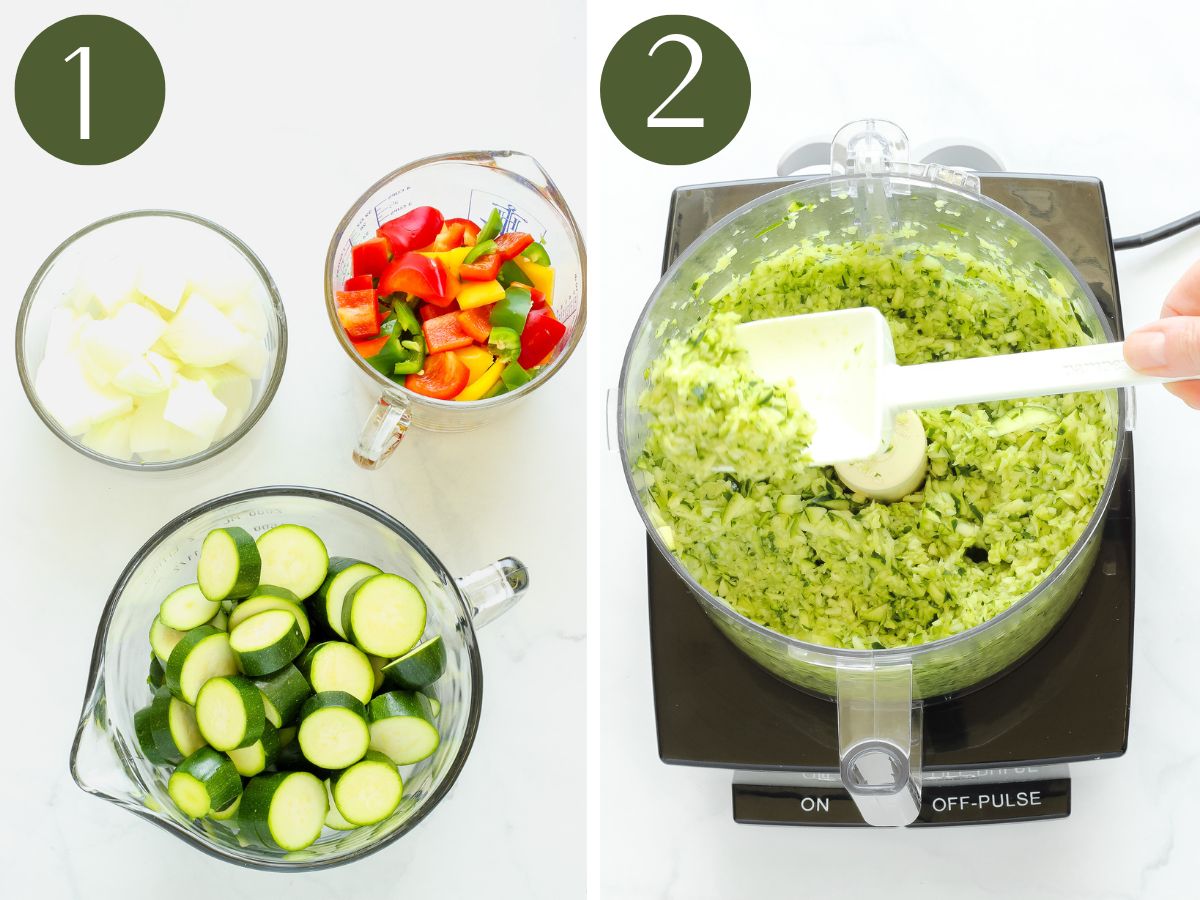
2. Mince the vegetables. You can do this by hand, but it’s so much faster and more efficient in a food processor. Pulse each vegetable about 15-30 times until it’s evenly, finely minced. Since they all have different textures, I recommend chopping each vegetable in the food processor one at a time, then moving on to the next. Aim for evenly minced vegetables.
3. Combine the vegetables and sprinkle them with salt. Mix the minced vegetables in a large bowl and sprinkle with the salt. Add about one tablespoon at a time and mix well as you add more salt. Transfer the minced vegetables to a colander set over a bowl, then refrigerate for at least 2 hours or overnight.
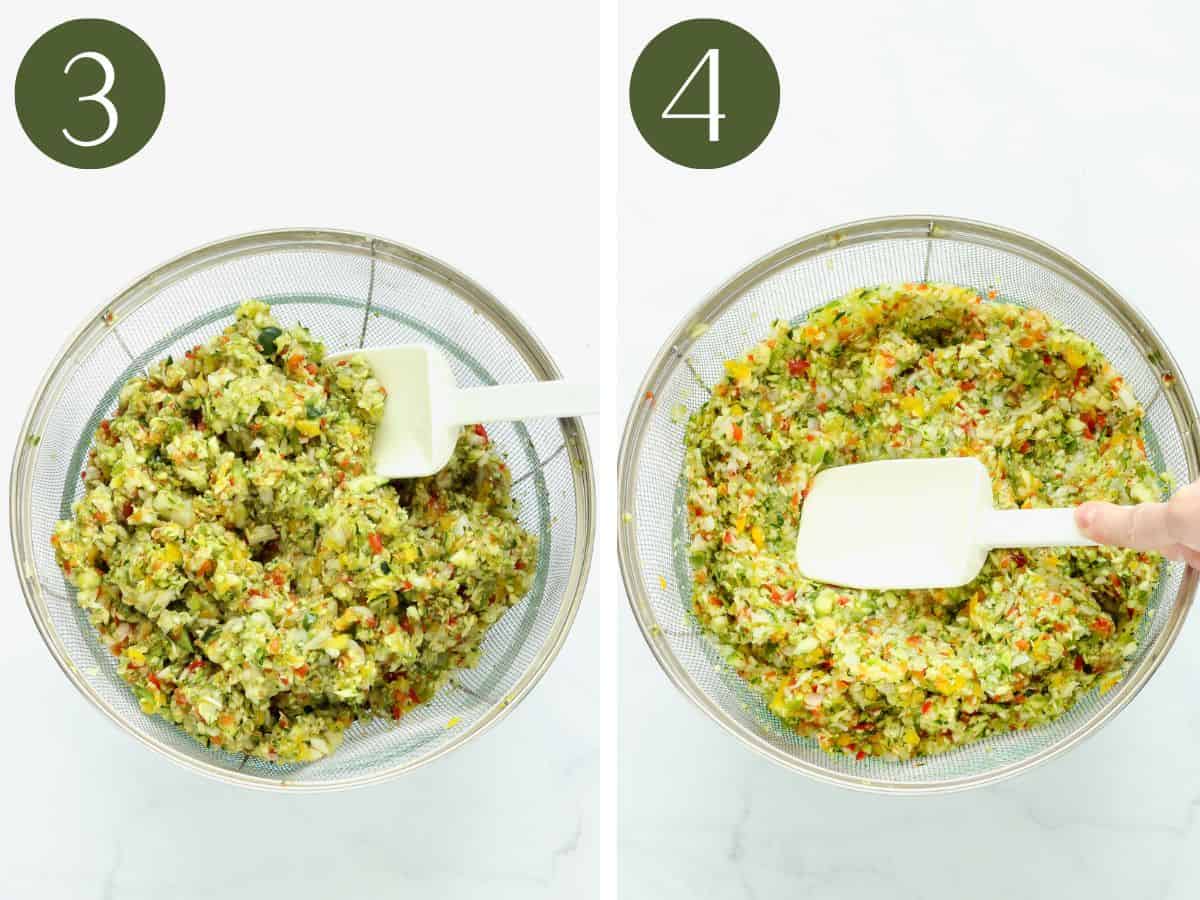
4. Rinse and press any liquid from the vegetables. As the vegetables brine in salt, they’ll give up a lot of liquid. When you’re ready to make the relish, rinse the minced vegetables to remove excess salt, then use a spatula (or clean hands) and press any extra liquid through the colander.
5. Simmer the brined vegetables. Combine the vegetables, vinegar, cornstarch, and spices in a large pot, and simmer for about 45 minutes until the liquid has reduced by at least 1/3
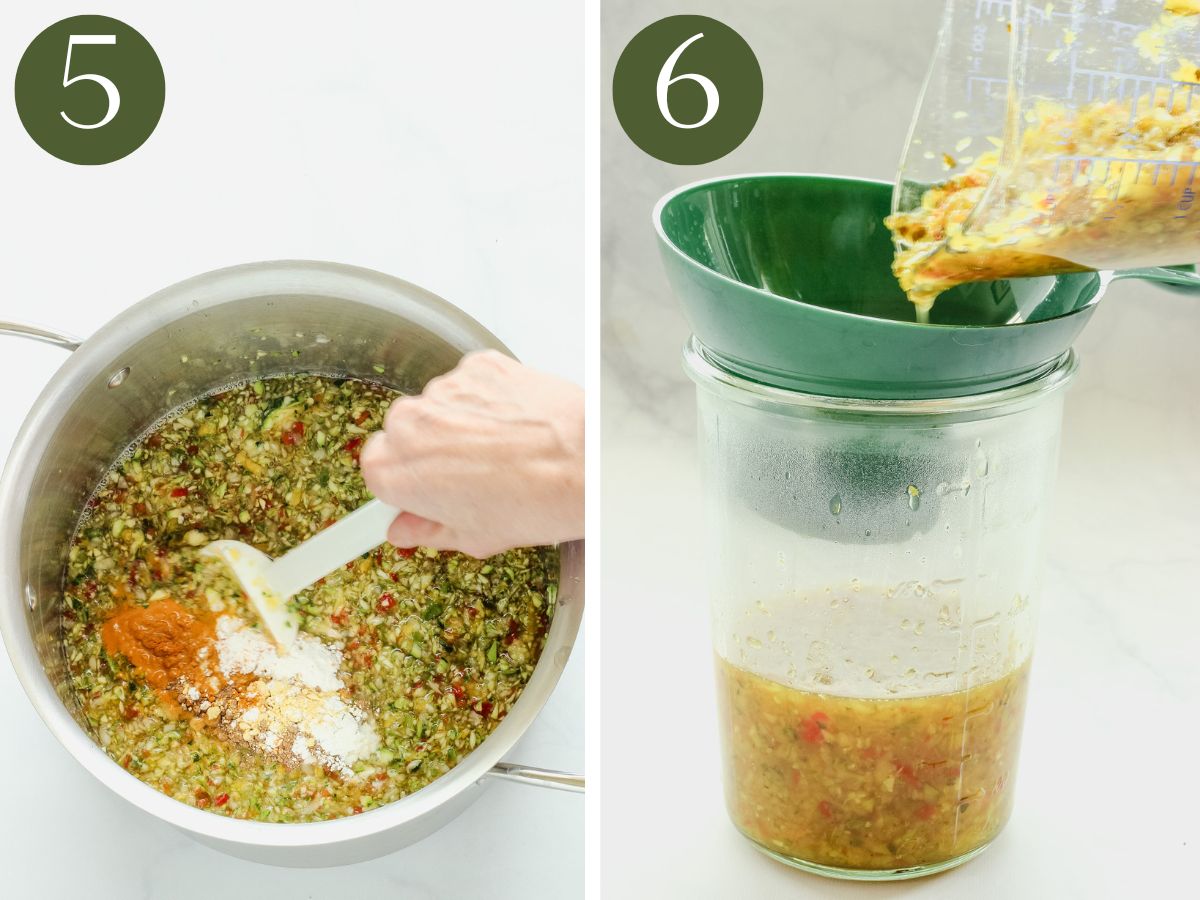
6. Transfer the relish into steralized jars. Use a canning funnel to avoid messy spills. This recipe makes about 8 cups. I use four to five 16-ounce (about 473 ml) pint-sized jars to store it. You can also use smaller or larger jars.
Canning and Storage Options
Refrigerator Storage
To store this zucchini relish in the refrigerator, pour or ladle it into jars. Wipe away any spills from the rims, and cover tightly with lids.
With refrigerator storage, you don’t have to put the jars in a hot water bath, so you can use plastic lids (instead of metal lids and bands) if you prefer. I love these universal plastic lids (they come in regular and wide-mouth sizes) because they’re dishwasher-safe and reusable.
This relish will keep for about 2 months in the refrigerator (unopened). Once it’s opened, use it within 2-4 weeks.
Freezer Storage
Freezer storage is a great option if you don’t want to can this zucchini relish in a water bath, but you want to keep it for longer periods. To freeze it, let the cooked relish cool to room temperature, then transfer it into freezer-safe containers, leaving at least ½ inch of headspace at the top of the container to allow for expansion as it freezes.
Silicone freezer containers work great. I also use “wide neck” or straight neck glass jars with plastic lids to freeze this recipe or others, like my homemade fig jam or easy pasta sauce, and have never had any cracking. However, narrow neck (standard) jars with shoulders are prone to cracking as food expands.
Once frozen, homemade zucchini relish will last up to a year. Note, however, that freezing will slightly change the texture, making the vegetables softer, but I don’t think that’s a problem with this recipe. Make sure you thaw it slowly in the refrigerator, not in a microwave.
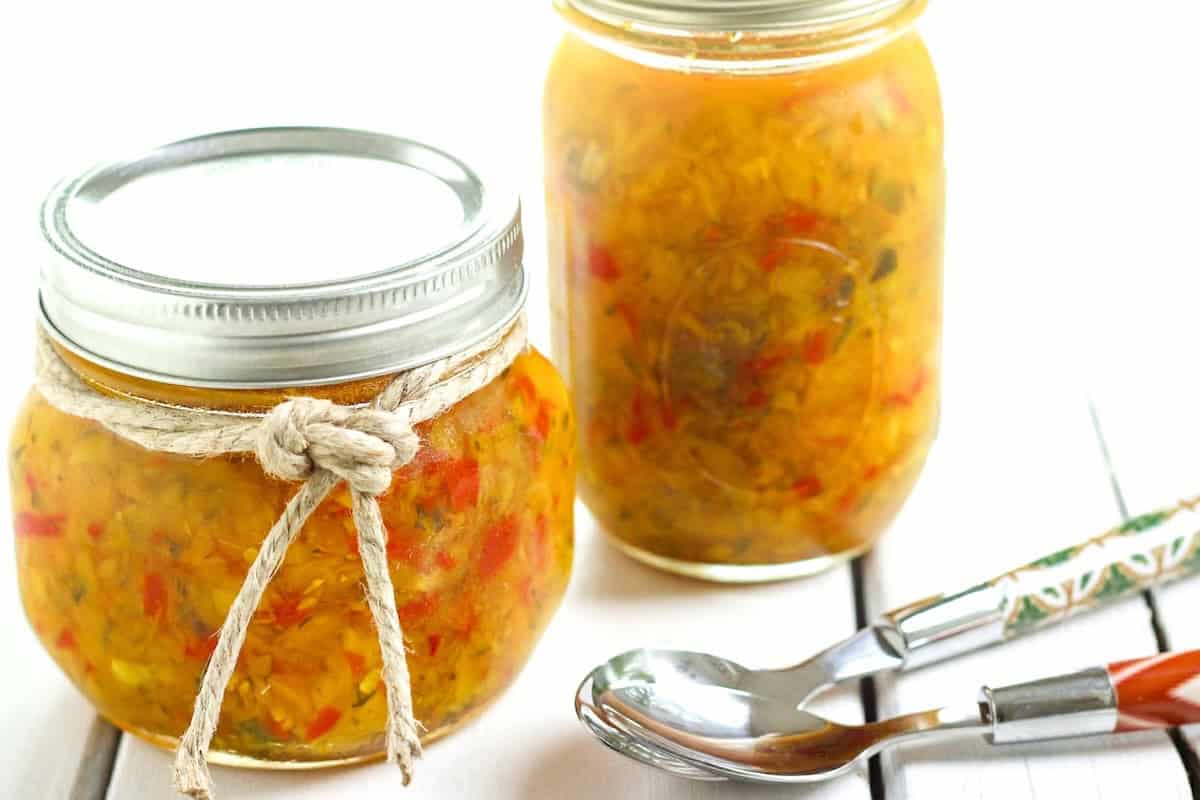
Water Bath Canning for Shelf-Stable Storage
Water-bath canning is ideal for long-term storage or gifting, because the vacuum-sealed jars of zucchini relish will last for at least two years. You can keep them in the refrigerator or in a cool pantry.
NOTE: For water-bath canning, it’s important to follow the recipe instructions. Do not eliminate or reduce the sugar or vinegar, as they are essential for safe storage.
If this is your first time canning, I highly recommend reading this article on the basics of water bath canning from Michigan State University Cooperative Extension. FYI: in the US, all state university cooperative extension programs offer excellent resources on growing, harvesting, and storing food.
To can this recipe in a boiling water bath:
- Set up your water bath and preheat the water to about 180ºF while the relish cooks. Make sure your jars are cleaned in hot, soapy water. Use brand new (unused) lids and rings to seal the jars.
- When your relish is ready, ladle the hot relish into clean pint-sized canning jars (make sure they’re safe for water bath canning), leaving about ½ inch of headspace at the top of the jar.
- Insert a small spatula or spoon into the jar and make sure there are no air bubbles. Then, center the lids on top of each jar and lightly screw on the rings. Don’t make them too tight, because oxygen needs to escape from the jars.
- Using a jar lifter (not your hands!), carefully place each jar into the water bath. Make sure there is enough water to cover the jars by one to two inches. Cover the water bath pot and bring it to a boil.
- Once the water bath comes to a rolling boil, set a timer for 15 minutes and let the jars process. NOTE: Process for 20 minutes if you live at an elevation of 1,000-6,000 ft, and 25 minutes if you live above 6,000 ft.
- Turn off the heat and carefully remove the jars using a jar lifter. Place them on a kitchen towel or cooling rack for 12-24 hours. Don’t shake or disturb them. As they cool (often within 10-15 minutes), you should hear a popping sound. This is the lid forming a vacuum seal.
- After at least 12 hours, check the seals. Look for an indentation in the middle bump of the lid. It should be curved downward (concave). If you press on the center of the lid, it should not spring up when you lift up your finger. Unscrew the band from each jar, and gently try to lift the seal with two fingers. If it doesn’t move, you have a tight seal. Screw the band on, then store the jar in a cool pantry or in the refrigerator for up to two years.
- If you have any lids that didn’t form a tight seal and you can lift them off the jar easily, store them in the refrigerator and use them first.

Expert Tips
- Always use the freshest vegetables you can find for this recipe, and wash them before cutting. Zucchini, peppers, or onions with broken skin, bruising, or soft spots might harbor bacteria, which will ruin the quality of your relish and might make you sick. Cut any suspicious areas away before chopping the vegetables.
- For a sugar-free zucchini relish, replace the sugar with Lakanto or Swerve, and store the relish in the refrigerator or freezer. NOTE: I contacted these companies directly, and they do not recommend these sweeteners for water bath canning. Use only real sugar for water bath canning.
- You may have more liquid than you need. I’ve reduced the vinegar in this retested version, because some readers mentioned they were left with too much liquid, but you may still have a little more than you need. Ladle enough liquid into the jars to cover the vegetables. Use any leftover pickling liquid to make homemade salad dressing or a marinade for chicken (combine it with olive oil and some Dijon mustard).
How to Eat Zucchini Relish
This relish takes your burgers, chicken sausages, or sandwiches to a whole new level. It’s also amazing mixed in with:
- Chicken, egg, or tuna salad
- Deviled or scrambled eggs
- Homemade potato salad
- Creamy pasta salads
- Cream cheese or Greek yogurt as a cracker or vegetable spread
Or, use it to make:
- Homemade Thousand Island dressing (mix equal parts zucchini relish, ketchup, and mayo and add a generous squeeze of lemon juice and a dash of garlic powder)
- Homemade tartar sauce (combine about ½ cup mayo, 2+ tablespoons zucchini relish, and a squeeze of lemon juice)
Recipe FAQs
While I personally love apple cider vinegar in this recipe, you can also use plain white, white wine, champagne, or red wine vinegar. Red wine vinegar will give your relish a more orange color. I don’t recommend balsamic or other dark vinegars because they’ll overpower the other flavors.
The lids on properly sealed jars usually have a slight indentation in the middle. They are also somewhat hard to lift away from the jar without using a knife or bottle opener. If they lift away easily and you don’t hear a vacuum sound when you lift the lid, play it safe and throw it away. This article from the University of Georgia on cooling and testing jars also has helpful tips.
The relish is somewhat thin and watery when you ladle or pour it into the jars. It will thicken up as it cools, and even more in the refrigerator.
No. Zucchini peel (especially if you’re using smaller, tender zucchini) is very soft and you won’t even notice it when everything is chopped and cooked.
Related Pickled Recipes
Love this recipe? Please leave a 5-star rating on the recipe card below & a review in the comments section further down the page. Your email will not appear publicly!
Sweet and Spicy Zucchini Relish (Refrigerator, Freezer, Canning Methods)
Ingredients
- 2 1/2 pounds zucchini ends trimmed and cut into thick slices (9-10 cups)
- 3 medium vidalia or other sweet onions diced (about 4 cups)
- 1 medium yellow pepper seeded and quartered
- 1 medium sweet red pepper seeded and quartered
- 3 large jalapeno peppers seeded and sliced
- 3 Tablespoons kosher or pickling salt
- 4 1/2 cups apple cider vinegar
- 3 cups sugar
- 1 teaspoon tumeric
- 1 teaspoon nutmeg
- 1 teaspoon dry mustard
- 2 teaspoons cornstarch
Instructions
- Place zucchini in the bowl of a food processor fitted with the chopping blade, and pulse until it's minced evenly. Repeat with onions, and then the sweet peppers and jalapeños. Place all of the vegetables in a large mixing bowl and toss with about 1 tablespoon salt. Stir well to combine, then add the remaining salt, a little at a time so it coats all of the vegetables evenly.
- Transfer the salted vegetables to a colander set over a bowl. Refrigerate for at least 2 hours or overnight to brine the vegetables.
- Discard the water from the vegetables and drain them well under cold water to remove excess salt. Use a spatula to press any remaining water from the vegetables.
- Transfer the drained, salted vegetables to a large stockpot. Add the vinegar, sugar, turmeric, nutmeg, mustard, and cornstarch to the pot. Stir everything well and bring the mixture to a boil. Reduce the heat to medium-low and simmer for 45 minutes or until the liquid has reduced by at least 1/3 and the mixture has thickened. Turn off the heat and let the relish cool for about 15 minutes so it's easier to handle.
- Ladle the relish into 4-5 clean, pint-sized jars, leaving about 1/2 inch of headspace. If storing in the refrigerator or freezer, let the relish cool to room temperature, then cover tightly and refrigerate for up to 2 months or freeze for up to 1 year.
- For water bath canning, please see my detailed instructions in the recipe post above. -Prepare and heat your water bath while the relish cooks.– Apply brand-new lids to the top of the hot jars and lightly screw on the rings.– Lower the covered jars into the water bath and make sure they're covered with at least 1-inch of water. Cover the water bath and bring it to a rolling boil. Once boiling, set a timer and process the jars for 15 minutes (below 1,000 feet), 20 minutes (1,000-6,000 feet), or 25 minutes (over 6,000 feet).– Remove the jars when finished, and let them cool on a towel or rack for 12-24 hours, undisturbed. Then, check the seals, tighten the rings, and store for up to one year.
Notes
Nutrition
If you print this recipe, you can scan the QR code below to see updates and tips or leave a comment.
Have you ever used the juice from the veggies in soup!
I haven’t Julie, but I’ll bet it would add a nice pop of flavor. Many creamy soups call for a tablespoon or two of vinegar.
If anyone’s wondering how long this lasts, I am eating jars of this from January 2020 (nearly 6 years ago) that I found in my pantry. Still tastes amazing and I’m not dead yet 🙂
Mine lasts a year in the fridge, NO CANNING Required!
Can you please confirm what the serving size is for the nutrition statistics? It shows Serving: 0g, which is obviously incorrect. :-). Planning on making this afternoon!
Hi Sandra, The serving size is about 1/4 cup. Enjoy!
I am getting ready to make a new batch of this because we’re love it and have gone through all i made previously. I froze my last batch in freezer bags with 1-2 c in each. It froze and thawed perfectly.
I’m so glad you love it Barb! Thanks for visiting and leaving a comment!
You mentioned using any leftover juice for pickling anotherproject. Could you give me an example of what you might pickle with it?
Hi Sally, you can add it to sliced cucumbers or zucchini to make regular pickles. Thanks for checking out the recipe!
This recipe looks good. I just don’t understand where the other 2 Tablespoons go. I want to make it today. I am worried I will have too salty of a relish. We toss with one Tablespoons but the recipe calls for three Tablespoons. Where do the other two Tablespoons go? Thank you
Hi Sally, In the recipe I recommend starting with one tablespoon, stir it in, and then add the remainder, little by little just so it’s easier to incorporate. Hope you try it!
Could you use a artificial sugar in the recipe please?
Hi Lora, I’ve never tried it but several people have left comments saying that it works.
I have and it does work well; I’m diabetic, so I always try to make recipes ok for me…I’ve never had any issues…hope this helps.
P.
Hi Sarah!
We have a ton of zuccs this year! We love our cucumber relish, and yours looks delicious.
Would you recommend canning – either cold- water bath or pressure?
If so, for how long?
Thanks, Gene
Hi Gene, I’ve only tested this as a refrigerator pickled relish, so I unfortunately, I can’t comment on canning time. Sorry!
I just canned mine. Hot water bath. 10 minutes in half-point jars. All worked wonderfully.
I always can mine to make shelf stable to enjoy over the winter. I always make huge batches…I have 4 left, just opened another one yesterday-tastes just as good as the day I made it last year. Hope this helps.
This can be canned using the water bath method. Time in bath, 10 minutes
What is the shelf life
Hi Janette, I usually keep this for at least 4 weeks in the refrigerator. I put it in smaller jars and they’ll keep a bit longer if you don’t open them until ready to use. I’ve never tested this recipe using a canning method so you must refrigerate it.
Made a batch today. It made 12 half pint jars full. I only used 2 3/4 cup vinegar and still had a little liquid to drain. My family’s recipe uses 6 cups of sugar so I was glad to find this one that used less! I also hot water canned the jars since there was no way we will eat that much relish in just a few weeks.
This looks so good! What a great way to use up a bunch of garden zucchini!
I have shredded zucchini from this year in the freezer. Could I use it? I apologize if you’ve already answered a similar question.
I think you can us it Anita, since everything cooks down anyway. Maybe use a bit less liquid. I’ve never tried that but let me know if it works!
I made this a year ago and canned it in water bath! It is better than my family recipe as less sugar and can make it anytime! Mine was with green tomatoes and tough to come by! I had way more than 2 quarts but veggies all bigger ! Perfect for liquid! Used your exact recipe and so yummy and processed maybe 15 minutes! Thanks so much and will be doing again very soon as I am almost out! Barb
Thanks Barb! That’s so good to know – so many people ask about canning it in a water bath. Glad it works and you like it!
Good to know as this is the best recipe I have found and would like to water bath can as well. Thanks!
I made this for the first time last night, it is runny, should there have been more cornstarch or less liquid?
Audra, you don’t have to add all of the liquid to your jars. I would just strain off any excess.
What to do with a 2 pound, 10 ounce zucchini? This! Yum! It made 5 pints! I used Leslie M.’s variation so I could can the relish. Also added a couple yellow banana peppers, as I only had a small red sweet pepper and a green. Also Serrano peppers instead of jalapeños, because we have an abundance, and like extra heat. Definitely works. The next time, I will make this with habaneros. Their fruitiness will complement the relish. With the extra sugar, it thickens enough the cornstarch isn’t necessary, and it cooks down in less than 30 minutes.
That’s one large zucchini! So glad you liked the recipe! Thanks for sharing how you made it your own 🙂
Can you process this so it lasted longer.
Hi Cathy, I’ve never tried it myself because it lasts for a while in the refrigerator. But I believe many people have tried it and found it to work fine – it’s pretty acidic so I think it should last well. Look through the comments and you’ll see suggestions people have left.
Let me know if it works!
I made it last year it was great and little bit hot now I’m doing it again today my friend’s and family loves it thank you so much love the Relish
Do you have to do the water bath? I usually sterilize jars lids etc and keep hot till I fill them then leave them in the counter until seals pop and then place on my preserve shelf would this be ok for the relish?
Hi Lisa, I’ve only tested this recipe with the refrigerator-pickling method so I can’t advise. Sorry!
I cooked mine for 30 mins but it is still too runny. Shall I put back in pan and cook some more
Hi Colleen,
The cooking is mainly to soften the vegetables. it won’t thicken up very much. When I put it into jars, I usually just add a little bit of the liquid with mostly the relish. Hope that helps!
The recipe says to put in sterilized jars. Can you tell me how you do that since I don’t have canning equipment.
Hi Michelle,
If you just run your jars through the dishwasher they’ll be good to go. Or if you have a tall stockpot, fill it with water, bring it to a boil and dip the jars in for a minute. You just want to make sure the jars are clean and free from any bacteria.
Enjoy!
Hi, I put my jars in the oven on low fan at 100 deg. C while I’m cooking the relish. Usually about 20mins or so. Lids go in as well. The relish goes into the jars hot. Usually the lids pop well.
Interesting! I’ve never heard of the oven method! Thanks for sharing 🙂
Wanting to make this relish. Recipe called for 3 Tablespoons of salt, divided. You only used 1tablespoon of the salt. When so I use the rest of the salt? Thanks, Donna.
Hi Donna, one tablespoon gets tossed with the vegetables to release some of the liquid, and the remainder goes into the pot with everything else! Enjoy!
I completely forgot about the rest of the salt and didn’t add it. It’s not cool yet, I guess I can add it now and put back on simmer a bit.
Oh shoot! I just saw your message Liz. If you’ve already canned it, just taste it when you open the jar and season it then.
Can you use yellow squash in place or mixed with the zucchini?
Hi Sara, Yes, Absolutely!
Does this recipe have to b refrigerated ?
Yes it does Gail – because it’s not heat processed. Some readers have mentioned that they heat-processed it though. If you look through the comments, you should see their suggestions.
Would it be possible to replace the cornstarch with arrowroot powder?
I have many allergies and intolerances and corn is at the top.
Thank you
Tammy
Hi Tammy – I think you could swap it or leave it out. It’s really just to thicken it up a bit.
I made the relish but I did change the of vinegar. 6 cups of vinegar would make it too sour so I went off of another relish recipe and it was equal amount sugar and vinegar so I used 3 1/2 cups of each and it was perfect. I also processed it for 23 minutes in a canner. Now the relish will last for a couple of years and does not need to be refrigerated. Thanks for the recipe it is delicious.
Thanks so much for sharing your changes and the canning technique Leslie! I’ll publish it so everyone can see. Glad you like it – I think it’s a great condiment to have on hand.
Was hoping this could be canned!!! Water bath canner or pressure canner?
Hi Kate – I’ve never tried canning it but a few people have asked and I haven’t heard anyone say it didn’t work. It’s pretty acidic so I think you’d be OK. Let me know if it works and I’ll update the recipe to mention it!
hi, I am excited to try this recipe. I did not grow jalapeno peppers, I grew pobleno peppers. Can I replace the Jalapeno for Pobleno?
Hi Lisa, of course you can! They just won’t be as spicy. If you want some heat, add about 1/2 teaspoon of dried chili pepper flakes. Enjoy!
Am wondering if it would make a difference if white vinegar was used instead of apple cider vinegar.
Hi Angela –
I think white vinegar would be fine. It just has a sharper taste, so you might want to add more sugar or cut it with some water. I used apple cider because it has a slightly sweeter, fruity flavor. Let me know how it works!
How much does this make? How many jars?
Hi Kathy, I’m so sorry – I recently updated this recipe and just realized the quantity doesn’t show up for some reason. I updated the recipe summary to say 8 cups. I usually get enough to fill 2 large, quart-size mason jars. I transfer it to smaller jars as needed. Enjoy!
can it be made with much less sugar? I am diabetic and love my veggies but can’t have all that sugar!
Hi Letha – I’ve never tried it without the sugar, but I think as long as you keep it refrigerated and use it quickly, you can try stevia or another type of sugar-free sweetener. I’ve seen sweet pickles made that way. Maybe try to halve the recipe the first time to see how it goes. Let me know how it works!
Any sugar substitute except aspertine is heating stable. So swerve, stevia, Splenda are all ok. I do recommend using cup for cup versions
Thanks for this lovely recipe ! I made it and simmered it for longer – until a lot of the liquid had evaporated, which is what I always do with any of my chutneys. When it’s done, you draw a line with a spoon through it, and it should take a few seconds for the line to fill up – then you know it’s ready. I then sealed it when still hot in warm, sterilised jars, with cellophane covers and lids.
Thanks for sharing the simmering tip Sarah! I’m so glad you enjoyed the recipe 🙂
Hi again Anne, It seems to have kept fine so far (13 days now) having warmed the sterilised jars and added the relish when hot and sealed straight away. It tastes absolutely delicious and I will be making a lot more of this with my courgette glut and will make enough to see us through till next year. I’m happy I reduced the mixture down and didn’t have to get rid of any liquid – more flavour that way too. It is fabulous in sandwiches (husband can’t get enough of it and eats it with everything!) , with bbq meats, with cheese….I also make the Hairy Bikers’ chicken tikka kebabs, and it is perfect with that. Thanks again for this recipe – it’s a real winner !
Thanks so much for letting me/us know Sarah! I’m so glad you like it, and I so appreciate the tips about heating the jars and reducing the liquid. I love it on everything too. It’s been a popular recipe, so I know everyone appreciates the info 🙂
This is what I did. When I simmered the relish, I also left the lid to the pot slightly open to release extra liquid. Liked the consistency.
This does seem like alot of vinegar but im gonna try it right now.
I thought so too, so I used half. Vinegar flavor was overpowering when it was done simmering, ended up adding an extra 2 zucchinis, still thought it was too much and strained some of the liquid out.
Personally, I still think it’s too much vinegar.
But thank you for the inspiration and all your other lovely recipes! 🙂
Thanks so much for your comment Madeleine! I will make this recipe again in a few weeks and see if it needs a vinegar tweak.
I was wondering, I saw a recipe very similar to yours here. But the only difference was it was 2 1/2 cups of vinegar, instead of the 12 you have listed here. That seems like an awful lot. Any chance it was a typo?
Hi Lori! Thanks for your question. This recipe makes a large batch and calls for several pounds of veggies, so that’s why there’s so much pickling liquid. You can probably cut it back a bit – I usually have some leftover, but it should be 2 parts vinegar to 1 part sugar.
I used the full amount of vinegar and it is a bit too much of a vinegar flavor. I have not put in jars yet. Anything I can do to fix it now!
Hi Tammy,
If it’s too tangy for you, add some water to the mix and discard some of the vinegar.
how do you tie that knot? I love the look of it around the jar.
Gosh Monica – I don’t even know – I just looped it and it worked! If you google decorative knots, you might find it. Thanks for visiting!
This sounds like something I want to can. What are the instructions for water bath canning this recipe? I like my relish shelf stable. Ideally, I want to use half pint jars. Any help you can give me would be appreciated.
Hi,
I’m so sorry but I’ve never canned it so I can’t help! There are specific acid levels needed for shelf stable canning so I’d check with an expert at your local university extension program.
i make a zucchini salsa and can that and keeps for a long time. Going to try this later today.
I have a variation of this recipe and use the hot water bath canning method with great success. After the 30 minutes of simmering, do not cool the recipe, rather ladle immediately into sterilized jars (hot pack method) and seal (lids/rings) using a water bath canner, processing for the time required (depending on recipe, I process my recipe for 10 minutes) with any additional adjustments according to your altitude. Hope this helps! http://www.freshpreserving.com/tools/waterbath-canning
Thanks so much for sharing the info Nancy! Hope it helps everyone who wants to use the canning method!
Please share how you canned it. I’ve been looking for recipes with all the zucchini in my garden that will last us through the fall.
Thanks in advance!
Hi Ashley and everyone else who is asking about canning. I wanted to share the link to the National Center for Home Food Preservation: http://nchfp.uga.edu
They have helpful info on canning and preserving, and probably an 800 number for questions. I wish I could help, but I know that most canning recipes require a certain ratio of acid to salt to vinegar, and I don’t want to give anyone incorrect info. If anyone has success, please share!
Hi Ashley and everyone else who is asking about canning. I wanted to share the link to the National Center for Home Preservation: http://nchfp.uga.edu
They have helpful info on canning and preserving, and probably an 800 number for questions. I wish I could help, but I know that most canning recipes require a certain ratio of acid to salt to vinegar, and I don’t want to give anyone incorrect info. If anyone has success, please share!
can you please share how you canned it Diane? Thanks.
I AM CANNING THIS RECIPE RIGHT NOW ! Ladle it Hot !
Hope you love it Diane! Thanks for visiting 🙂
Please let us know how you did it and how it turned out. Thanks.
How about freezing it?
Thanks 🙂
Hmmm I never thought about freezing this Holly. I’m not sure how the vegetables would hold up and I think the relish might be end up mushy, but the flavor would still be there. Maybe make a small batch and try it and let me know! Wish I could be of more help :/
I made this recipe and froze in quart freezer bags with 1 c in each bag. It froze and thawed wonderfully and tastes great. Getting ready to make another batch this week as we’ve used up all of my initial batch. This is great on hot dogs and brats, i use it in tuna salad, sandwich spread, egg salad. I use it to make tartar sauce. We love it.
I froze mine in 1-2 c amounts in freezer bags and it froze and thawed perfectly.
Thank you!
You’re welcome Christina! Thanks for stopping by and I hope you like the recipe 🙂
My husband thinks 6 cups of vinegar is to much and that I must be reading the recipe wrong. Is it 6 cups red wine vinegar? Thanks
Hi JoAnn, Yes, I do use 6 cups of apple cider vinegar (I’ve never tried it with red wine vinegar). You will have liquid left over though, which you can use to pickle something else or else discard.
Hi! So I was wondering if you could can this to keep it longer?
Hi Christina! I honestly can’t advise on the canning process since I’ve never tried it. Most canning recipes have specific requirements for the amount of salt/sugar/acid in the product in order for it to keep longer and be shelf stable, and this recipe wasn’t created with that in mind. I think if you’re going to refrigerate it, you could get a tighter seal and a bit of longer life, but I wouldn’t advise storing it without refrigeration. Hope that helps!
Christina I was wondering the same thing. Cause I was going to can it. So did u can it. And if so. How did it turn out.
Christina I am making Zucchini relish by the case. I use a lot of it in my pasta salads and potato salad along with using on hotdogs. I can mine and have nothing be Splendid results. I live in New Mexico and I hot water bath for 23 minutes same as I do my Hot Salsa made with green chili and jalapenos. Look on the BALL CANNING WEBSITE and find your elevation and it will tell you how long to process.
Thanks so much for sharing! I’ve posted your comment on the recipe for those who would like to try canning.
My grandmother makes a relish almost exactly like this and can it. It lasts forever but i cant remeber at the moment what the process is.
Hi Kierstyn – I few people have chimed in with canning suggestions, and I’ve added their comments to the string. I wonder if you called your local extension school – they might be able to offer some suggestions. Thanks for stopping by!